
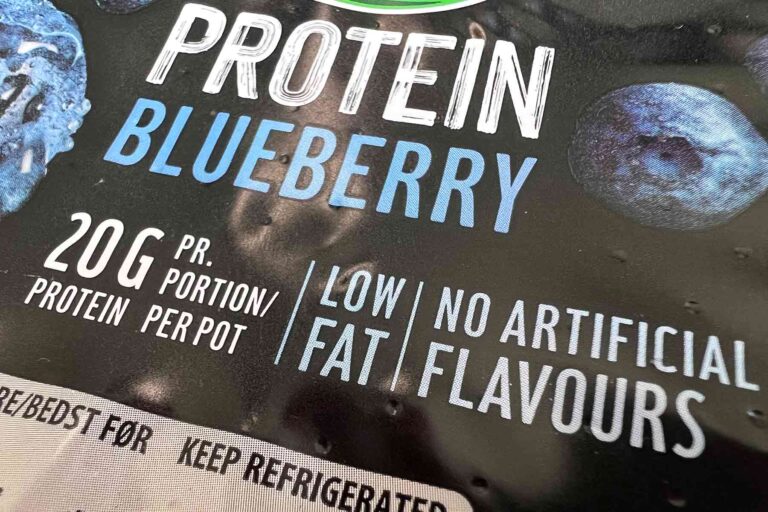
Being able to understand the labels on food and drink means you can make informed choices about your nutrition and your health and wellbeing.
We hope this easy guide to food labels will help.
Especially if you buy your work lunch from a supermarket or sandwich shop.
It can be difficult to understand the complexities of food labelling. What does ‘low in added sugar’ and ‘high in fat’ really mean?
Do you know what is best for you? High protein or low GI. What even is GI? (GI stands for glycaemic index, by the way. We digest food with a low glycaemic index more slowly. They can increase the guts hormone response to food and therefore help you to avoid overeating at each meal. Foods with a high GI are digested and absorbed quickly, causing a spike in blood sugar.)
While it is great to see labelling on foods, some manufacturers are making health claims that appear to be good but maybe aren’t that beneficial to us in the long term.
So how do we know what works for us? Well understanding the label is a terrific way to start.
Easy guide to food labels
Label: ORGANIC
If 95% of prepacked food is organic, it can be labelled as such. You can check by looking for the soil association logo.
Label: LOW SALT
To avoid high blood pressure, it is recommended that we consume less than 6g of salt per day. Remember, that about three-quarters of all the salt we eat is already in the food that we buy. To be classed as ‘low salt’ then the food must have less than 0.3g per 100g.
If you see sodium on a list of ingredients, remember that sodium is just one part of salt (sodium chloride) so you will need to times the sodium amount by 2.5 to get the salt content.
Label: HIGH FIBRE
Fibre is a type of carbohydrate that your body is unable to break down. It helps to keep your digestive system healthy and moving. The fibre in your diet can help reduce the risk of heart disease and stroke, type 2 diabetes and bowel cancer.
For a food to be classed as ‘high fibre’ it must contain more than 6g of fibre per 100g or at least 3g per 100 calories.
Watch out for products that claim to be ‘a source of fibre’ as this is from 3g per 100g or 1.5g per 100 calories.
Label: HIGH PROTEIN
High protein has become a buzzword in recent times and can be found on many products. Protein is an essential nutrient and is responsible for building tissue, cells and muscle, as well as making hormones and antibodies. Athletes consume higher levels of protein because they train more and their muscles need to recover and grow.
High protein is when 20% or more of the calories are provided by protein. Like the fibre claims, remember ‘a source of protein’ means that 12% of the calories are produced by protein.
Label: LOW FAT
Your risk of heart disease increases if your cholesterol is too high and this can be caused by too much fat in your diet – especially saturated fats.
If a product claims to be low fat, that means it must have 3g or less per 100g. ‘Reduced fat’ on a label just means that it must have 25% lower fat than the standard product.
Remember that ‘reduced fat’ foods tend to be those with extremely high fat contents to begin with. Also, beware that low fat versions often have added sugar.
Label: NO ADDED SUGAR
The NHS says that adults shouldn’t consume more than 30g of free sugar per day. Free sugar is sugar that isn’t naturally already in food or drink. Foods labelled ‘low sugar’ contain less than 5g of sugar per 100g.
Hopefully, this guide will help you navigate the complexities of food labels. But remember, everyone is different and the best way to eat healthily is by consulting a registered nutritionist or one of our personal trainers.