
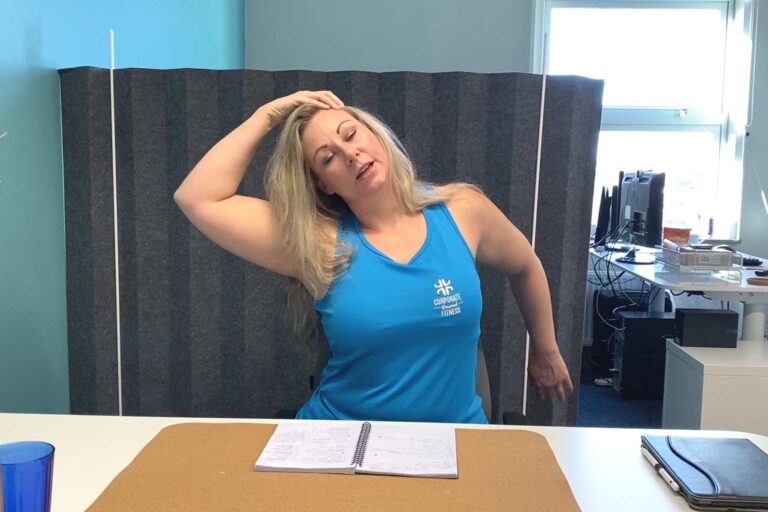
Did you know you can get your daily yoga fix from your workstation?
Many people are unaware of the benefits of yoga or struggle to fit a regular practice in around their daily lives.
At present, whilst enduring the pandemic, more people are working from home and most of us are under an increased amount of pressure, at home and work. Some people are working from home at make-shift workstations; this can lead to tight muscles, poor posture. Many people are working longer hours; ‘work-life’ slowly slips into ‘home-life’ with less time to ‘switch off’ and relax.
In Western society, most of us are over-stimulated; we can watch several screens at once, we can contact people on the other side of the world at any time using a variety of methods. We literally have the world at our fingertips.
Constant stimulation, long working hours, poor work-life balance, and poor posture can lead to many physical and mental health conditions. Incorporating yoga into our daily life can help to relieve stress and tension. In fact, the Yoga Sutras of Patanjali teaches us in Sutra 1:2 “Yoga citta vrtti norodhah”; “yoga helps to calm the chatter of the mind”; the aim of yoga is to start to “turn down” the thoughts, pressure and stimulation like “turning down” a radio (or smartphone these days!)
Emma Usher, our registered dietitian and yoga teacher outlines a short yoga practice that you can perform at your desk or workstation:
- I invite you to start by coming towards the end of your chair, plant your feet onto the earth (remove your shoes and socks if able), sit up onto your sit bones (tilt your tail bone down and pull up out of the lumbar spine). Rest your hands onto your thighs with the palms facing the sky. Close your eyes or soften your gaze. Tilt the chin towards the chest to lengthen into the neck and have the crown of the head parallel with the sky.
- Notice the thoughts chattering in your mind. Stand back and watch those thoughts for a few moments.
- Notice how your body is feeling. Scan your body from the crown of your head to the tips of your toes noticing any areas of tension or tightness and asking each body part to release and let go.
- Take your awareness to your breath for a few moments; try to hold your awareness here. This can be difficult at times when our thoughts are particularly noisy. Notice any thoughts that come up and guide your awareness to the breath when you are ready.
- As you exhale, drop your right ear to your right shoulder, inhale back to centre. Alternate side to side in your own time with the breath. This will ease into the sides of the neck and the shoulders. Do at least six to each side. Finish with the left side & bring the head back to centre.
- As you inhale take the arms overhead, as you exhale, lower the arms into the side of the body. Repeat this at least six times. Let the fingertips reach the end of the movement at the end of the breath. Try to keep your full awareness here.
- Place the fingertips onto the shoulders and start to circle the shoulders as dynamically as possible; as if you are putting on a cape, then change direction.
- Rest the hands back onto the thighs. Do some pelvic tilts here. Imagine you have a little ball that you are rolling from the navel to the pubic bone as you exhale and from the pubic bone to navel as you inhale. Repeat this at least six times.
- Bend your right knee out to the side and rest your right ankle onto the left thigh. Apply a little gentle pressure onto the right thigh. You may feel a gentle stretch into the right hip and buttock. Hold this for three breaths. Swap legs. Bend the left knee and rest the left ankle onto the right thigh. Apply a little gentle pressure to the left thigh.
- Stretch your right leg out straight and lift the toes. Hinge from the hips and fold the body forwards towards the toes. The arms can reach around the back of the thigh, calf, ankle or earth. Lengthen the breastbone. You will feel a stretch into the back of the right thigh. Hold for at least three breaths and change sides.
- If possible, hug the knees into the chest and have a little rock here. If it is not possible to hug in the knees wrap your hands around yourself in a ‘hug’ and take a moment here.
- Rest your hands once more onto your thighs and check you are sitting on to your sit bones with the neck long and shoulders away from the ears.
- Take a moment to watch the breath once more. Try to do this for a few minutes keeping your full awareness here.
- Make some small movements – wiggle the fingers, have a shake and come back to the room.