
For many busy professionals, finding time to exercise during the working week can feel like an impossible task.
Long hours at a desk, back-to-back meetings and competing personal commitments often mean that physical activity is pushed to the bottom of the priority list. However, incorporating a short, structured workout into your lunch break can make a meaningful difference to both physical health and mental wellbeing.
A lunchtime workout does not need to be intense, lengthy or require specialist equipment. In fact, simple bodyweight movements performed consistently can improve strength, mobility, posture and energy levels — all of which support productivity and focus during the rest of the working day. Even 10–20 minutes of movement can help counteract the effects of prolonged sitting, reduce stress and boost mood.
Below are five simple, accessible exercises that can be performed at your workplace, with little space and no gym equipment.
These movements can be completed individually or combined into a short circuit, making them ideal for busy workplaces and hybrid working environments.
Squats
Squats are one of the most effective full-body exercises you can include in a lunchtime workout. They primarily target the muscles of the lower body, including the quadriceps, hamstrings and glutes, while also engaging the core and supporting spinal stability.
To perform a squat, stand with your feet roughly shoulder-width apart. Keeping your chest upright and core gently engaged, bend your knees and hips as if you are lowering yourself onto a chair. Aim to keep your weight through your heels rather than your toes. Lower as far as feels comfortable, then push through your heels to return to standing.
For those new to squats or concerned about technique, using a chair as a guide can be helpful. Lightly tap the chair with your hips before standing back up. This can improve confidence and ensure safe depth.
Squats are particularly valuable for people who spend most of the day sitting, as they help maintain strength in muscles that support everyday movements such as standing, walking and climbing stairs. Over time, regular squatting can also improve joint mobility and posture.
Incline Push-Ups
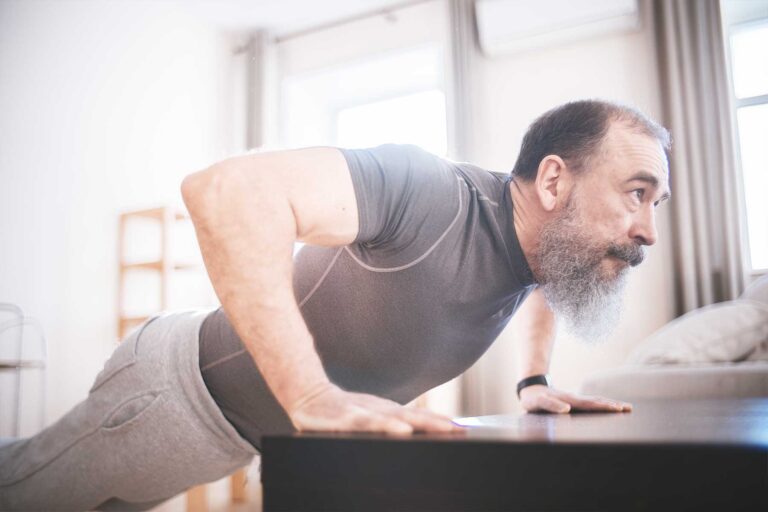
Push-ups are excellent for strengthening the upper body, but traditional floor push-ups are not always practical or accessible in the workplace. Incline push-ups provide a more achievable alternative while still offering significant benefits.
Using a sturdy desk, table or wall, place your hands slightly wider than shoulder-width apart. Walk your feet back so your body forms a straight line from head to heels. Lower your chest towards your hands by bending your elbows, keeping your core engaged and neck neutral. Push back up to the starting position.
The higher the surface, the easier the exercise becomes. Wall push-ups are ideal for beginners, while desk-height push-ups provide a greater challenge. This flexibility allows individuals to work at a level that suits their strength and confidence.
Incline push-ups strengthen the chest, shoulders, arms and core, and can also help counteract the rounded shoulder posture that often develops from prolonged desk work.
Lunges
Lunges are an effective lower-body exercise that also challenge balance and coordination. They target the glutes, quadriceps and hamstrings, while engaging the core to maintain stability.
To perform a forward lunge, stand tall and step one foot forward. Lower your hips until both knees are bent, aiming for roughly a right angle at each knee. The back knee should move towards the floor without touching it. Push through the heel of the front foot to return to standing, then repeat on the other side.
If space is limited, lunges can be performed in place rather than walking forwards. Holding onto a chair or desk can help with balance if needed.
Lunges are particularly beneficial for reducing muscle imbalances between the left and right sides of the body. They also mimic everyday movements such as stepping and walking, making them highly functional for daily life.
Desk or Wall Plank
Core strength is essential for good posture, spinal health and injury prevention — especially for those who sit for long periods. Planks are a simple yet effective way to engage the core muscles without needing to lie on the floor.
For a desk or wall plank, place your forearms or hands on a desk or wall and walk your feet back until your body forms a straight line. Engage your abdominal muscles, squeeze your glutes gently and keep your shoulders relaxed away from your ears. Hold this position while breathing steadily.
The angle of the plank can be adjusted to suit different ability levels. A wall plank is more accessible, while a desk-height plank increases the challenge. As strength improves, individuals may choose to progress to a floor-based plank outside of work hours.
Regular plank holds can help reduce lower back discomfort, improve postural awareness and support overall movement quality.
Calf Raises
Calf raises are often overlooked, but they play an important role in lower-limb strength, circulation and balance. They are also extremely easy to perform in any setting.
Stand with your feet hip-width apart and slowly rise up onto the balls of your feet, lifting your heels off the floor. Pause briefly at the top, then lower your heels back down in a controlled manner. Holding onto a desk or chair can help with balance.
To increase the challenge, calf raises can be performed one leg at a time or on the edge of a step to allow a greater range of motion.
Strong calf muscles support walking, standing and stair climbing, and can also help reduce stiffness and fatigue in the lower legs — particularly for those who sit or stand for prolonged periods.
Bringing It All Together
These five exercises can be combined into a simple lunchtime circuit. Performing each movement for 30–45 seconds, followed by a short rest, allows for a balanced workout that can be completed in as little as 10–15 minutes. This makes it easier to fit physical activity into even the busiest schedules.
Encouraging regular movement during the working day benefits not only individual employees but also organisations as a whole. Improved energy levels, reduced musculoskeletal discomfort and enhanced mental wellbeing can all contribute to better engagement and productivity at work.
For businesses looking to take a more proactive and long-term approach to employee wellbeing, creating a dedicated wellbeing space can be a powerful step.
A workplace wellbeing centre can provide opportunities for movement, recovery, education and support, helping to embed healthy habits into the working culture.
If you are interested in enhancing wellbeing within your organisation, you can explore how to develop a wellbeing centre at your workplace here.