
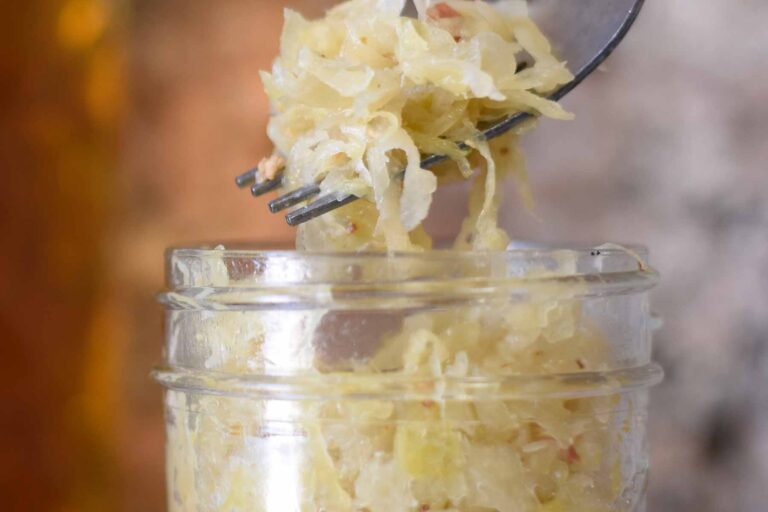
Making probiotics (bacteria) can confer a lot of health benefits, in things such as sauerkraut and kombucha, a type of fermented tea and kefir a type of fermented yoghurt.
Fermenting food is an ancient process of preserving food and in modern times has become trendy for its taste. Nowadays, it has become even more popular because of the claims that consuming probiotics helps promote weight loss, reduces gut inflammation, and surprisingly, can impact your mental health.
Sauerkraut is easy to make too. Try this recipe.
What are the benefits of probiotics and what is the best way to get them?
In recent years there has been a surge in research into the gut microbiome. There are thousands of different species of microbes that live in your gut and they have a profound effect on your health.
The gut microbiome is made up of around 100 trillion microbes. A mixture of bacteria microbes and fungi. All in all, they weigh about two kilos. That’s just a bit more than your brain. They make up about half the cells in your body. So we are half-human, half-microbiome!
Your gut microbiome is like a complex rainforest. Just like a rainforest, there is a rich diversity of life battling for survival. We know that the microbiome can influence our immune system and alter the activity of our natural killer cells – a vital part of our body’s defences. Some of them can turn the fibre in our diet into anti-inflammatory compounds.
This is good because chronic inflammation can lead to conditions such as type 2 diabetes, heart disease and dementia.
Perhaps the most surprising link is that between your gut and your brain. The ancient Greeks believed that mental disorders arose when the digestive tract produced too much black bile. Now we know that it is the hidden microbiome that may be shaping our actions. Psychobiotics is the name given to microbes that can impact our mood.
A recent study involving over 700 volunteers found those who ate the most fermented foods had the lowest levels of social anxiety.
Dr Kisten Berding Harald from University College Cork said: ”We do get more and more evidence that taking probiotics does benefit your mental health. A lot of this has prevoiusly come from animal studies. We do see some translation into human studies. We specifically need to know which probiotics are the ones that can benefit our mental health.
“In my study, we used a whole dietary approach. So instead of giving capsules that just had probiotics, we included macrobiotic friendly food such as whole grains, some fermented foods, fruit and vegetables.
“We told the participants to eat that particular diet for four weeks and we measured how their bacteria had changed and how their mood changed. Following the diet for four weeks, they felt a lot less stress and had an improved mood. The preliminary results suggest that it does help your mood and mental health to eat a diet that is microbiome friendly.”
The fibre helped with the anti-inflammatory aspect. But what about the fermented foods in the study? Dr Berding Harald added: “So it was moistly kefir, sauerkraut and kimchi. The participants had two to three servings a day.”
A word of caution. If you have a low fibre diet or haven’t had fermented foods before, Dr Berding Harald recommends easing into it.
There are also foods to avoid that can have a toxic effect on good bacteria. These include processed foods, high-fat foods, fried foods high sugar foods,
Work is going on to test psychobiotics on people with depression and it’s looking positive.