
We all want a quick and straightforward way to improve our mental and physical wellbeing.
Aerobic exercises such as running walking, cycling, and swimming are immensely popular these days. They are especially good for your heart and lungs.
But if you add resistance exercises to your daily routine, you will reap the benefits many times over. Exercises such as these can boost your brain too.
Resistance exercises such as press-ups or squats are easy to do. You only need to do a few minutes and no special equipment is needed.
Press-ups can help tone your upper body and squats the lower body. Together they are an amazingly effective combination.
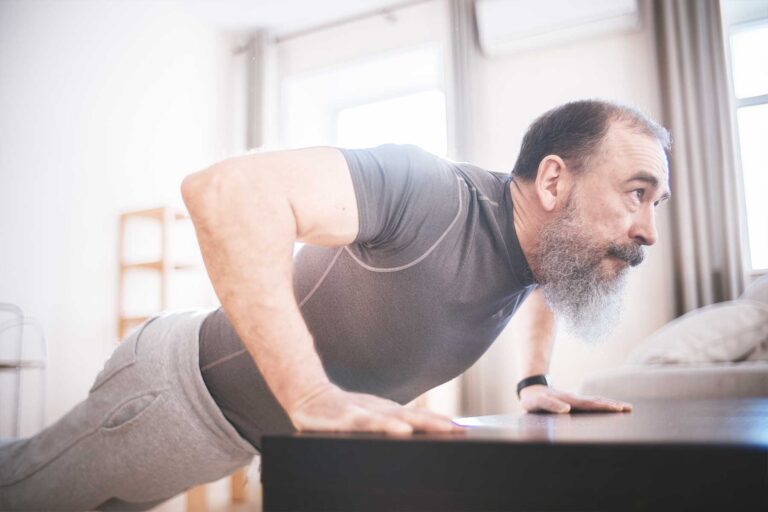
Press-ups help you build upper body strength, working your triceps, pectoral muscles, lower back and core. They can be done anywhere.
There is new research on the benefits of strength exercises even including an improvement in sleep.
Research into press-ups says they may reduce the risk of heart disease. A recent American study involving firefighters found that those who could do forty press-ups or more in one go when they were in their late 30’s were far less likely to have a heart attack in the next ten years than those who could only manage less than 10.
Forty is a big ask though and like any exercise, it’s best to begin gradually and work your way up. Starting with just a couple every day will prevent you from pulling a muscle or getting tendonitis. Try doing them against the wall at first and or whilst kneeling.
However, if you have an existing back problem, please speak to one of our personal trainers before you add these exercises to your daily routine.
If you’re not too sure how to do them properly, we can help you.
Professor Damian Bailey is a Professor of Physiology and Biochemistry and the Director of the Neurovascular Research Laboratory at the University of South Wales. He has been looking at exercises that particularly target the brain. His findings were remarkably interesting.
“We have looked at not your usual exercises like running or walking or cycling but focussing on squat stands, intermittent squatting down and standing up,” said Professor Bailey. “This is an intelligent way of exercising in as much as we’re intermittently challenging the brain with an increase in blood flow and then a decrease in blood flow. This toing and froing from high-flow to low-flow challenges the inner lining of the arteries that supply the blood to the brain.
“We think it’s good because it releases the good chemicals that the brain needs to grow to become more intelligent.
“The evidence is becoming increasingly clear that different parts of the brain grow and blood flow to different parts of the brain can also increase, including, for example, the hippocampus. The hippocampus is a key area as we get older.”
Over time blood flow to the hippocampus decreases and this leads to cognitive decline and Alzheimer’s.
So how effective are strength exercises compared to aerobic ones?
Professor Bailey said: “We have identified that three to five minutes of squat stands, three times a week is even more effective in terms of how well the brain is adapting, performing and responding to that exercise than thirty minutes of steady-state exercise.
“So, it’s almost a mini form of interval training for the brain and you aren’t huffing and puffing. You are not completely out of breath and you really do feel as if you are working less hard aerobically compared to for example a thirty-minute run or walk.”
Even if you have not exercised before a regime like this can be highly beneficial.
Prof Bailey added: “We have identified that people who have had a lifetime of doing no exercise – they actually respond even better to some of these exercises than people who have been active and then start to engage in a different exercise training protocol. So the brain still has plenty of opportunity to benefit from these types of exercise.”
Remember if you are frail or haven’t exercised before, please consult a professional – call one of our personal trainers or make an appointment to see your GP.