

Long hours at a desk can sometimes lead to some painful postural issues.
Rounding of the shoulders, hunched back, pointing chin and phone cradling are all issues arising from continuous desk hours in the workplace.
In the short term, these can lead to mild discomfort. However, over time they can become chronic issues with long-term pain and postural issues.
In this article we will focus on rounding shoulders and steps to prevent long-term pain and postural dysfunction.
Steps to prevent ‘rounding of the shoulders’ for desk workers.
The first thing to consider when looking at poor posture is your chair itself. Most office chairs will support your back correctly and promote a healthy sitting position. A good chair for work will offer lumbar support and maintain contact with your back all the way up through the thoracic region of the spine.
Your chair should also allow you to have your hips slightly higher than your knees, with a slight gap from the edge of the chair to behind your knee.
Your feet will be flat on the floor and preferably your arms supported at around a 90-degree angle. You can adjust your chair to suit your body.
As a next step, full DSE assessments are offered by all employers to ensure the proper ergonomic set-up of your desk.
For those self-employed or working from home, the requirement remains the same and an online DSE could be beneficial. A DSE will help you to set up your workstation at home or in the office, ensuring everything is in its place and set to prevent injury and increase productivity.
Areas covered include chair set up, desk height, screen set up and any commonly used items including keyboards, mice, phones, and stationery. Also considered is lighting, both natural and internal lighting, heat, space, and sound.
Just because everything is set up correctly doesn’t mean it’s okay to sit for long periods. One of the most beneficial things you can do to prevent chronic injury is to stand up and move about. Discover how often you should stand up.
Sometimes, physical intervention is required to alleviate the symptoms arising from rounded shoulders. Simple stretches at your desk throughout the day can help reduce stiffness, fight fatigue, and improve our overall wellbeing.
An example of stretching to help can include seated rotations. Whilst seated, cross your arms over your chest and grab your shoulders. Rotate your upper body from your waist. Turn gently from left to right as far as feels comfortable. You should feel tension on both sides of your mid to lower back as it stretches out.
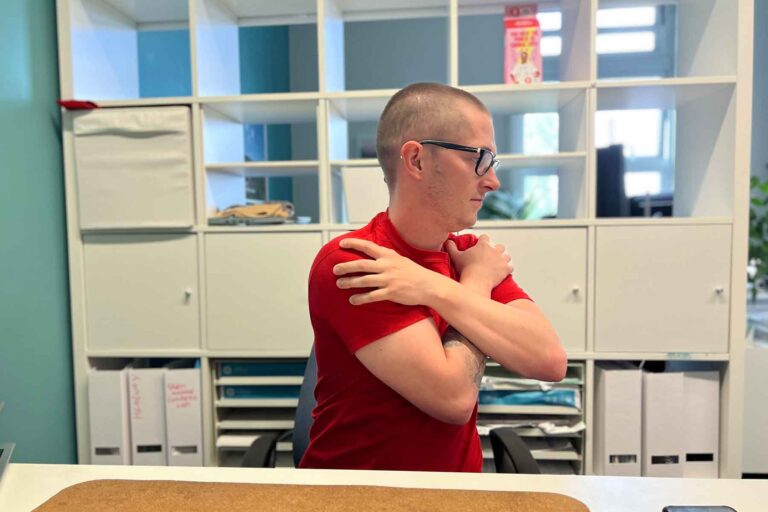
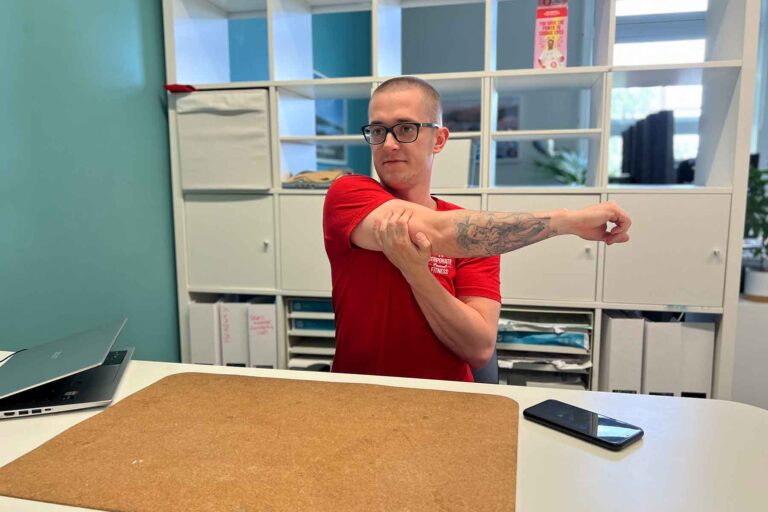
Another great example to reduce shoulder rounding is, of course, a shoulder stretch. Bring your right arm across your body, and support with your left by the upper or forearm. Feel the stretch in your shoulder and use the supporting arm to further the stretch if needed. Switch over for both sides.
A third could be the doorway stretch for your chest. Position your elbows and hands in line with a doorframe, elbow in line with your shoulder. Step through the door slowly, until you feel a stretch. Hold this end position for 15 to 20 seconds before returning to the starting position.
A deep tissue or sports massage can help with rounded shoulders too. Targeting the specific areas associated with the dysfunction, massage can relieve trigger points, decrease pain, improve posture, and improve blood flow.
A postural and movement assessment can help the therapist to identify the key muscle groups affected and through massage and trigger point therapy to relieve the tension and allow for improved posture, decreasing pain.