
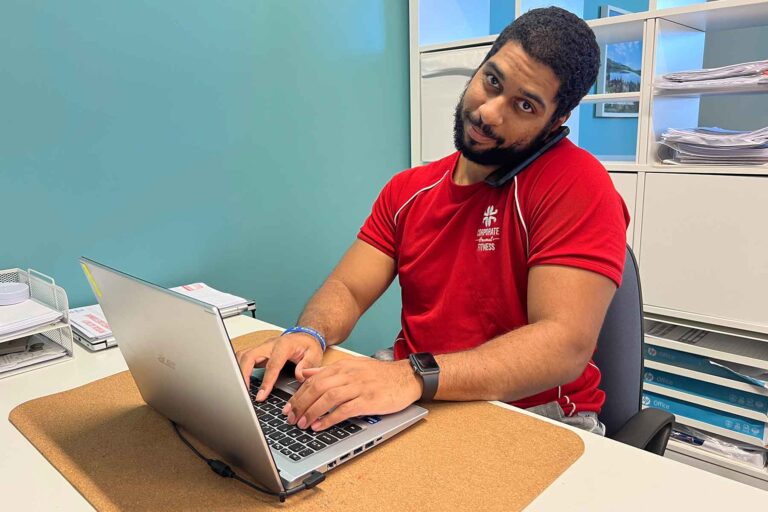
Spending a long time sitting at a desk may lead to long-term painful problems.
But you can do something to prevent rounding of the shoulders, hunched back, pointing chin and phone cradling.
These issues may be mildly discomforting at first. But as time goes on, they can become chronic issues with long-term pain and postural issues.
Today we will focus on the dangerous habit of phone cradling and steps to prevent long-term pain and postural dysfunction. We will focus on office and mobile phone use, especially phone cradling and its effect on our bodies.
Fast-paced workflows, the pressures of deadlines and the need to multitask at work sometimes lead us to find hands-free options for our phones.
A common misuse of mobile, office and even home phones is the habit of phone cradling. This is when we support the phone by tilting our heads to our shoulders. It’s a position most of us have seen or even done and it makes our hands available for typing or writing, but at what cost?
Prolonged periods of your head being tilted can cause torticollis or wry neck. The most found cause in the workplace can be due to muscular imbalance and strain, muscular torticollis.
When noticed and corrected early, muscular torticollis can cause nothing further than neck strain. If repeatedly holding our head in an unnatural position due to phone cradling, symptoms can include frozen shoulder, headaches, chronic pain and even difficulty breathing. Less common symptoms include migraines and eyesight issues due to misalignment of the eyes causing constant strain.
Steps to prevent ‘phone cradling’ for desk workers.
1> Firstly, always make sure your workstation is set up correctly. Consider a one-to-one DSE assessment that looks at you, not just your immediate environment.
2> We have briefly discussed standing in the workplace and invited you to Discover how often you should stand up. Sometimes mobility, space and environment can be an issue, so why not consider desk-based exercise?
3> Simple yet effective, our head and neck stretching, and exercises can help alleviate the pain and discomfort found from being in a desk environment for prolonged periods.
3.1> Standing with your back to a wall, tuck your chin down as far as is comfortable and feel the stretch down the back of your neck. Hold for five seconds, and slowly return your head to the wall in an upright position. Repeat six to eight times.
3.2> For neck rotations, sit in your chair with good posture and shoulders relaxed. Turn your head to the left, as far as is comfortable for you, and hold for three seconds. Slowly return to the centre and repeat on the right-hand side. Repeat three times on each side, seeing if you can gradually increase the range of motion.